
You’re Not Paying for the Model. You’re Paying for the Conversation.
PG-000 and PG-001 already tell you to keep sessions short and to work outside the chat. This guide is the other half of that instruction: what a long thread and a wasted turn are actually costing you.
A practitioner guide for the reader who keeps running out
The problem
You run out, and you do not know why.
Not the dramatic version. The ordinary version. It is Wednesday afternoon, you are partway through something that matters, and the platform tells you that you have reached your limit and can continue in a few hours. You were not doing anything extravagant. You did not run a hundred queries. You have no idea which part of your day was expensive and which part was nearly free, because nothing in the interface has ever told you.
The verification guides in this series have each answered a version of one question: is this output trustworthy. Did the model actually read the document. Does the citation say what it was claimed to say. Did the file keep the sections nobody asked it to touch. Is that confident sentence a fact or a guess. Those are the right questions and they remain the core of the discipline.
This guide asks a different one. Not whether the answer is good, but what getting it cost. Those two questions are independent. You can do everything else in this series correctly, verify carefully, route deliberately, and still hit the wall halfway through the week with no idea what drained the tank.
The answer is often not the model you chose. It is the conversation you were holding when you chose it.
Why it happens
Here is the mechanism, and almost nothing about the way these products are presented to you makes it visible.
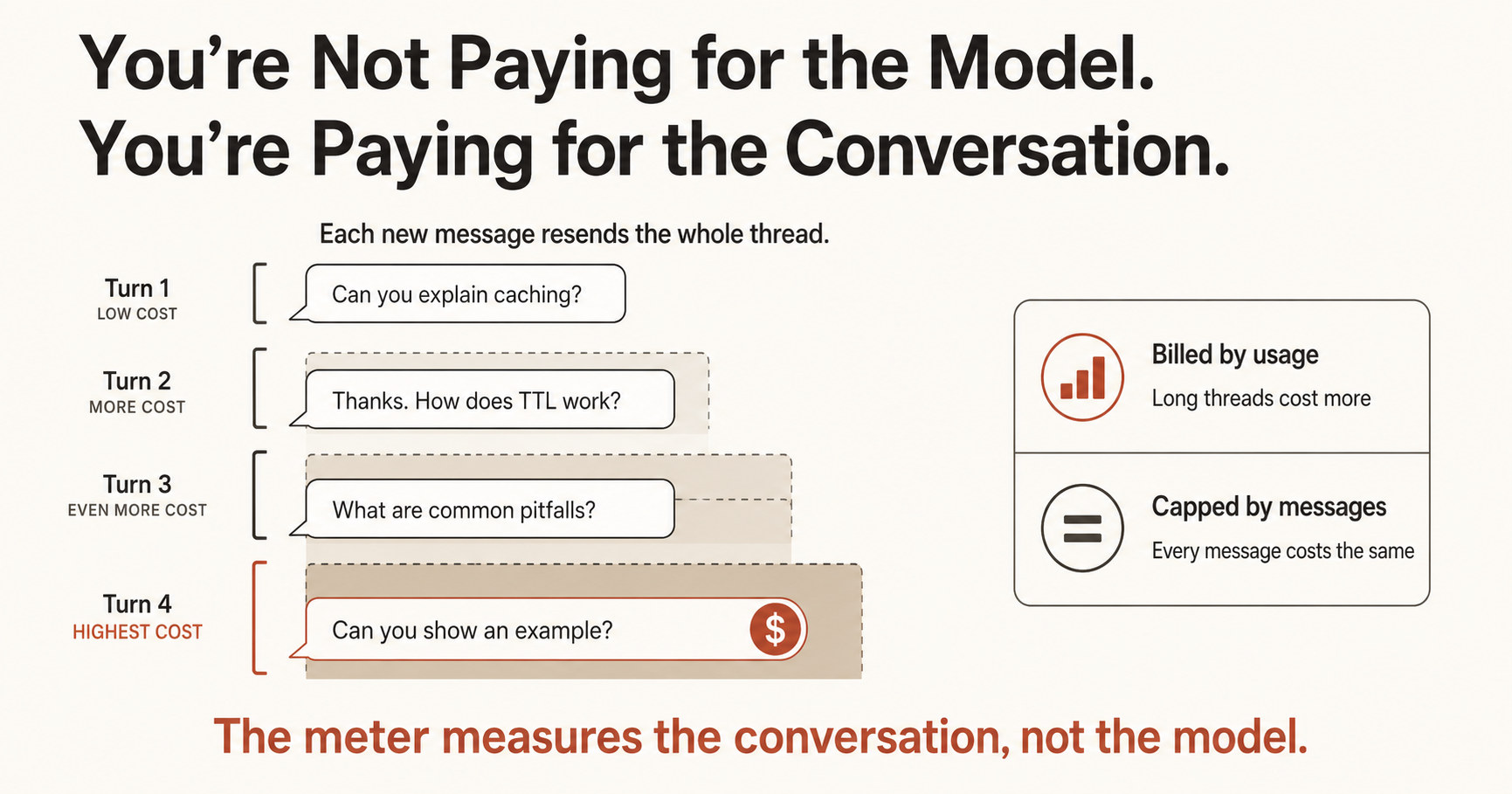
A chat is not a program that stays running. Within a single thread, the model has no memory of the exchange from one message to the next, and it does not sit between your messages with your conversation loaded. What creates the very convincing impression of memory is that the conversation so far gets sent back through the system each time you send a new message. Your first question, its answer, your correction, its revision, the document you pasted in at turn three, all of it, resubmitted as context so the model can produce the next reply. Cross-chat memory features, where a platform offers them, are a separate mechanism layered on top and do not change this.
Ask a question at the top of a fresh chat and you are paying for that question. Ask the identical question forty messages into an existing thread and you are paying for that question plus forty messages of history, every time. Same words from you, materially different cost. And the long thread is not the one that answers better: PG-001 makes the fidelity case that a drifted context produces drifted output, which means the expensive version of the question is also the one more likely to come back wrong. It compounds in a direction most people never think about: every message you add to a thread makes every future message in that thread more expensive than it would otherwise have been.
Platforms do reduce this in various ways. The most common is caching the repeated portion so that resubmitted history bills at a lower rate than fresh text. That genuinely helps, and it is why the effect is not as brutal as the raw arithmetic suggests. What it does not do is stop the repetition from growing. A discount on a number that keeps climbing is still a number that keeps climbing. Some platforms go further than caching and compact a long thread, summarizing or dropping the oldest turns rather than carrying them forward verbatim. That changes what gets resent, but not the underlying pressure: the cost tracks how much context each turn has to carry, and that still grows as the thread grows.
This mechanism is the one people are least likely to be looking at, because it is the only one the interface never shows you. Model choice is visible. Prompt length is visible. The accumulated weight of the thread you are already sitting in is not.
Where it actually goes
Two things to be clear about before the specifics, because both of them bound everything that follows.
Platforms meter differently. Some count messages, some count usage that scales with how much conversation each message carries, some run rolling windows that refresh over a few hours, and most do not publish the arithmetic. You often cannot determine exactly what you are being charged for.
The same caution applies to every specific named below. Plan structures, model names, tier boundaries, window lengths, and pricing all change, sometimes quickly. Nothing in this guide depends on any of them. The mechanism is the durable part: the prior conversation is carried forward as context, so length costs; turns and tokens are different currencies with opposite optimizations; and the expensive step is cheapest when it runs last on the smallest input. Read the specifics as illustration. Carry the structure.
With that said, three things are being spent. Two of them, money and tokens, are the same meter read at different resolutions. The third, turns, is different in kind and optimizes in the opposite direction. Which one you are rationed on changes what you should do about it, and most people do not know which one applies to them.
| Meter | How you are billed | What gets expensive | The move |
|---|---|---|---|
| Money and tokens | Per unit of text processed, so every message carries the thread above it | Long threads, re-supplied documents, thinking modes left on, regenerates | Keep threads short, supply material once, turn the mode off for mechanical work |
| Turns | Per message within a window, regardless of how long the message is | Clarification round trips and negotiation before the work starts | Front-load message one, spend turns only on judgment |
Money
If you are billed by usage, on an API-style plan or a pay-as-you-go tier, your bill is not proportional to how much work you did. It is proportional to how much work you did multiplied by how long your conversations were while you did it.
That is an uncomfortable formula, because thread length feels like a matter of convenience rather than expense. Keeping one chat open all week is tidy. It is also the single most expensive habit available to you, and it is invisible on the invoice, which arrives as one number with no breakdown by conversation.
Tokens
Tokens are the unit underneath the money. Even if you never see a token count, this is what is being consumed, and a handful of ordinary habits drive it up without ever announcing themselves.
Accumulated conversation is the largest one, for the reason above.
Re-supplied material is the second. Paste a long document at turn three, and it is already being resubmitted with every subsequent message. Paste it again at turn twenty because you are not sure the model still has it, and now two full copies ride along with everything that follows. The instinct behind the second paste is sound: PG-003 exists because models genuinely do lose their grip on documents. The instinct is right and the execution is expensive. When you find yourself wanting to re-paste, that is the signal to start a fresh thread with the document and a short summary of where you got to, not to double the freight on the thread you are in.
Reasoning and thinking modes are the third. These generate a substantial quantity of text working through the problem before the answer arrives, and on a metered plan you are paying for that text. PG-014 already argues for turning thinking off on faithful-reproduction work, on the grounds that more reasoning is actively the wrong tool when you want the model to do exactly what you said. The cost argument runs alongside it: for retrieval, formatting, extraction, and mechanical edits, you are buying deliberation you did not need and cannot use.
Regenerating is the fourth, and it surprises people. A regenerate is not a partial redo. The whole conversation goes back through again to produce the new answer. Three regenerates on a long thread is three full re-runs of everything above.
Turns
Where the cap counts messages rather than usage, you are not rationed on tokens in any way you can see. You are rationed on messages within a window, and this inverts the advice completely.
When the meter counts messages, a one-line question and a carefully constructed paragraph cost you exactly the same. Brevity buys you nothing. Which means the expensive habit is not writing too much, it is spending turns on negotiation instead of work: a vague opening message, a clarifying question back, your correction, a second attempt, and now you are four messages in and the actual task has not started. That round trip is pure loss, and it is the most common way people burn a message-capped allowance.
The response is to front-load. Put the constraints, the format, the audience, the length, and the thing you actually want into message one, so that message one is the working message. This is also why PG-000’s practice of keeping your standing instructions in a file you can paste pays for itself twice: once in fidelity, once in turns you did not have to spend re-establishing them.
The risk surface
Here is why a guide about cost belongs in a series about reliability.
Watch what people actually do when they are running low. They do not stop working. They start economizing, and they economize on precisely the wrong things, because the verification steps are the ones that feel optional.
They skip the review pass, because asking the model to critique its own draft costs another turn and the draft looks fine. That is PG-004’s failure mode, arrived at through the budget door rather than the impatience door: you accept the first adequate answer, not because you were careless, but because you were rationing.
They skip the second opinion, because running the output past a different system costs a turn on a platform where they are already short. That is PG-011 abandoned at exactly the moment its value is highest, on finished work about to leave their hands.
They skip the ingestion check, because confirming the model actually read the document is two messages before the real work starts and two messages is a lot when you have eleven left.
And then there is the perverse one. Trying to conserve, they start sending shorter and vaguer prompts, on the theory that less input means less consumption. On a message-capped plan this is exactly backwards: the vague prompt buys a clarification round trip, and they spend three turns getting to where one well-formed message would have taken them.
The intervention
Six practices at the message level, followed by one project-level move in the section after this. None of them require a different subscription and none of them require knowing your platform’s billing internals.
One task, one thread. This is the highest-value habit in the guide. When you move to a new piece of work, open a new conversation. Do not run a week of unrelated tasks down a single chat because it is convenient to have everything in one place. Carry a short handoff paragraph into the new thread, three or four sentences covering the goal, the constraints, and where you got to, rather than dragging the entire history with you. PG-001 already recommends the fresh start on fidelity grounds, because a drifted context produces drifted output. The cost reason points the same way: a fresh thread resets the freight.
Front-load the first message. Constraints, format, audience, length, and the actual request, all in message one. The clarification round trip is the most avoidable waste there is, and on a message-capped plan it is the most expensive.
Supply material once, on purpose. Attach or paste the document deliberately at the start, verify ingestion per PG-003, and then do not re-supply it. If you reach the point of wanting to paste it again, start a fresh thread with a clean copy instead.
Match the mode to the task. Thinking and reasoning modes on for genuine reasoning with dependent steps. Off for retrieval, formatting, extraction, and faithful reproduction. You are paying for deliberation in both currencies, and on reproduction work it degrades the output as well.
Spend scarce turns on judgment. When the meter is tight, the question to ask before each message is whether this turn requires the model to decide something. Retrieval, reformatting, tidying, and mechanical restructuring generally do not. Those are the turns to consolidate or handle yourself.
Use a free account on a second platform as your check. This is the highest-value move available to a reader with limited access, and it is close to free. Most of the major platforms currently offer some level of free use. That is a currency you are not metered on for the work you care most about protecting. Run your finished output past it with adversarial framing, per PG-011. Free tiers are usually tighter on length, so this works best pointed at a finished artifact you want findings on rather than at a full working session. You do not need three subscriptions to get a decorrelated second opinion. You need one paid account and one free one, and you spend the free one entirely on finding what is wrong.
Sequencing the expensive step
The last idea is about ordering, and it is the one that changes how a whole project consumes rather than how a single message does.
Most people lead with their most capable and most expensive setting, pointed at the widest version of the problem. Everything is unfiltered at that point, so the expensive model is doing its most expensive thinking across the largest possible surface, most of which will turn out not to matter.
Invert it. Do the broad work on the cheaper setting: the exploring, the drafting, the sorting, the ruling-out. Narrow the problem down while it is cheap to be wrong. Then bring the expensive setting in once, at the end, pointed at something that has already been filtered down to what actually needs judgment.
Two things make this work in practice. Ask the expensive pass for findings rather than a rewrite, since a list of problems costs a fraction of a full regenerated document and leaves you in control of what changes. Then take those findings back down to the cheaper setting to execute them, because executing a specified change is not the part that needed the expensive model.
A word on which model belongs where. That question already has a guide: PG-014 covers platform behavior, tier selection, effort, and thinking mode, including the observation that mid-tier models handle faithful document work well and that the lightweight tiers are not reliable for it. This guide does not re-argue any of that. What it adds is the reason the decision matters to your budget rather than only to your output: tier choice is not a one-time decision, it is a decision that repeats on every task of that type, at your most expensive rate, every time you fail to revisit it. Get it wrong once and you pay for it continuously.
An honest note
The Monday-morning checklist
- Find out what you can about which currency you are rationed in. Some plans publish it and most do not. Knowing broadly whether you sit on a usage meter or a message meter is enough to pick the right optimization, and it is more than most people have ever checked.
- Open a new conversation for your next new task, even though the old one is right there and still open.
- Before your next real request, write the whole thing into one message: constraints, format, length, and the actual ask. Notice whether you needed the follow-up you were expecting to need.
- Look at your longest current thread. Count how many separate unrelated tasks are in it. That is how many fresh threads it should have been.
- The next time you want to re-paste a document because you are unsure the model still has it, start a fresh thread with the document instead.
- Check where the thinking or reasoning toggle is on the platform you use most, and turn it off for your next formatting or extraction task.
- Set up a free account on a platform you do not pay for, and use it for your next adversarial review pass instead of spending a metered turn on it.
- On your next multi-step project, do the exploring on the cheaper setting and bring the expensive one in once, at the end, asking for findings rather than a rewrite.
The point
The meter is not really measuring the model. It is measuring the conversation, and the conversation is the part you control.
That matters for the obvious reason, which is that running out is inconvenient and expensive. It matters more for the reason this series exists. When the allowance runs low, the first thing to go is never the work. It is the checking: the review pass, the second opinion, the ingestion verification, the extra turn that would have caught the citation. Budget discipline and verification discipline turn out to be the same discipline, approached from opposite ends. You cannot afford to verify if you have already spent everything on the conversation.
Guides covering the foundational skills for working reliably with any AI system.
- PG-000: 10 Things Every AI User Should Do
- PG-001: How to Work Reliably With Conversational AI Over Time
- PG-002: AI-Assisted Editing Without Silent Loss
- PG-003: Verify Before You Work
- PG-004: You Are Accepting the First Adequate Answer
- PG-005: Your AI Updated the File. Did It Preserve What It Didn’t Touch?
- PG-009: Make the AI Show You the Source
- PG-010: Don’t Trust What the AI Says About Its Own Work
- PG-011: The Cross-AI Adversarial Review Protocol
- PG-012: Make the AI Tell You What It’s Guessing
- PG-013: You Don’t Have a Model Problem. You Have a Method Problem.
- PG-014: You Don’t Have a Method Problem. You Have a Routing Problem.
- PG-015: You’re Not Paying for the Model. You’re Paying for the Conversation. (this guide)
New articles in full, plus a short note on each new paper, by email: Subscribe on Substack →
Further reading
This guide is the cost companion to the routing and method guides, and it defers entirely to PG-014 on which model belongs where.
- PG-014: You Don’t Have a Method Problem. You Have a Routing Problem. Which platform, which tier, which effort level, which mode. The routing decision this guide defers to entirely.
- PG-001: How to Work Reliably With Conversational AI Over Time The operator’s rule set, including the case for the deliberate restart. This guide supplies the cost reason for the same instruction.
- PG-000: 10 Things Every AI User Should Do The baseline practices, including keeping standing constraints in a file and treating the chat as scratch paper rather than storage.
- PG-003: Verify Before You Work: A Minimal Sequence for AI Document Ingestion The ingestion sequence to run once, at the start, so you never need to re-supply the document mid-thread.
- PG-011: The Cross-AI Adversarial Review Protocol The review pass to run on a free second-platform account.
- PG-004: You Are Accepting the First Adequate Answer The failure mode that rationing produces, and the reason a cost guide belongs in a reliability series.
- PG-013: You Don’t Have a Model Problem. You Have a Method Problem. The argument that method, not model, governs output quality.
Full framework documentation available at the Synthience Institute community on Zenodo.
A note on evidence
The mechanism this guide rests on, that each new turn has to carry the prior conversation forward as context and that the cost of a turn therefore grows as that context grows, is how these systems are documented to work. Platforms differ in the details, some resend the thread verbatim, some cache it, some compact it once it runs long, but the direction is the same under all of them.
Everything downstream of it is behavioral observation from sustained first-hand use across several platforms, not benchmark results and not billing data. I cannot see your meter, and the guide’s own argument is that you frequently cannot either. The claims about which habits cost the most are offered to be tested against your own usage rather than taken on faith. Plan structures, tier boundaries and pricing will also move after this is written, which is why the guide is built on the mechanism rather than on any current number.