
Verify Before You Work: A Minimal Sequence for AI Document Ingestion
This guide expands practice #1 of PG-000: 10 Things Every AI User Should Do.
A copy-ready prompt sequence for confirming AI document ingestion before work begins
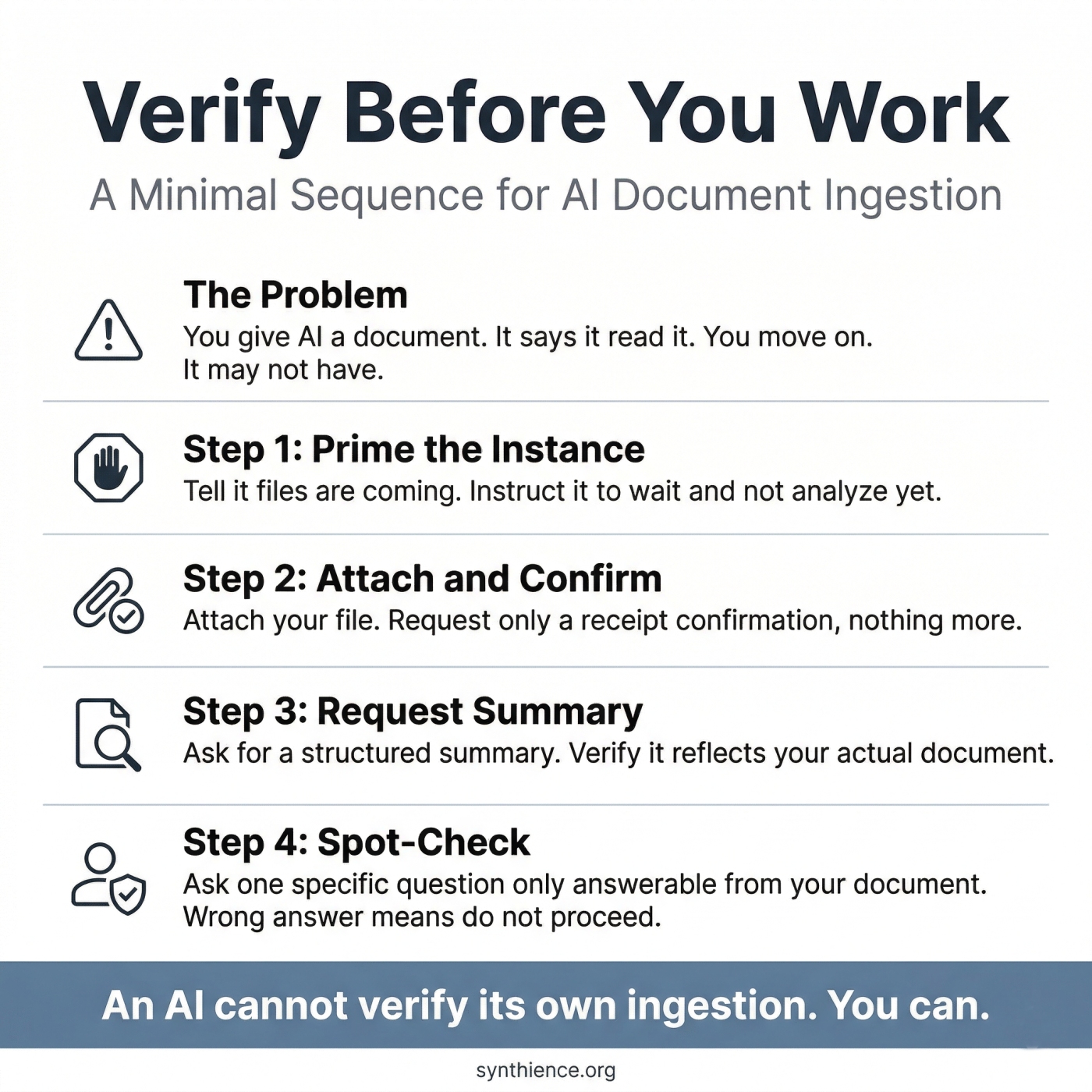
The problem in one sentence
You give an AI a document, it says it read it, and you move on. But it may have processed only part of it, reconstructed content it did not actually read, or lost critical details that will only become visible when something goes wrong later.
Who this is for
Anyone who gives an AI system a document — a report, a contract, a specification, meeting notes, a research paper, anything — and then expects it to use that document reliably in the work that follows. This is especially relevant in enterprise environments where AI tools handle documents as part of routine workflows.
This guide does not require technical knowledge. It requires only the ability to copy a prompt and read a response.
Why this is a real problem, not a theoretical one
AI systems are optimized to produce fluent, plausible responses. When they have not fully processed a document, they do not say so. They fill gaps with reconstruction: text that sounds correct and may be mostly correct, but may also be missing constraints, inverting details, or substituting approximations for specifics.
Enterprise AI tools in particular — including tools built on Microsoft Copilot and similar platforms — can fail silently when documents are attached. The system acknowledges the file, appears to proceed normally, and produces output that looks reasonable. The gap between what was actually in the document and what the AI used is not visible until you look for it.
The sequence in this guide makes that gap visible before you rely on it.
The minimal working sequence
Three required prompts, one optional verification step, then your actual work begins. Each step below shows the exact prompt to send and what a valid response looks like.
Step 2 — Attach and confirm receipt only
Step 3 — Request summary and verify it reflects your actual document
Step 4 — Spot-check with a specific question (optional but recommended)
Step 5 — Begin your actual work
Text in this color is a placeholder: replace it with your actual content.
Step 1 — Prime the instance
Send this first, before attaching any files
This step exists because some AI platforms begin processing attachments the moment they are received, which can cause fragmented or incomplete ingestion. Separating the attachment step from the analysis step forces a cleaner processing sequence.
Step 2 — Attach the files and confirm receipt
Attach your file or files, then send this
The purpose is confirmation without processing. You are establishing that the files are present in the session before asking the AI to do anything with them.
Step 3 — Request ingestion and summary
This is the verification step
Read the summary critically. You are not looking for a perfect summary. You are looking for evidence that the AI processed the actual content — your structure, your terms, your specific details — rather than producing a generic response about what a document of this type typically contains.
Step 4 — Spot-check (optional but recommended)
Ask something only answerable from the actual document
Choose a question that has a specific, verifiable answer in your document. Avoid questions that the AI could answer correctly from general knowledge without having read the file.
Step 5 — Begin work
Only after the summary and spot-check are satisfactory
At this point you have externally confirmed that the document is present in the session and that the AI has processed it to a degree adequate for your purpose. You can proceed with reasonable confidence.
When to use this
Use this sequence any time you are providing a document that the AI will need to use reliably: contracts, specifications, policies, reports, research, meeting notes, procedures. The longer or more specific the document, and the more your work depends on its details, the more important this sequence becomes.
For short or low-stakes documents where you can easily catch errors, Step 3 alone — the summary request — is often sufficient.
What this sequence does not guarantee
This sequence confirms that the AI has processed your document adequately at the start of a session. It does not guarantee that the AI will continue to use it faithfully throughout a long conversation. In extended sessions, document fidelity can degrade as context grows. If your session runs long, re-grounding periodically — re-stating key constraints or re-asking targeted questions — is good practice.
Five guides covering the foundational skills for working reliably with any AI system.
New articles in full, plus a short note on each new paper, by email: Subscribe on Substack →
Further reading
This guide implements a simplified version of the Ingestion Verification Protocol, a formally specified methodology for observable AI document processing developed at the Synthience Institute.
- Video: The Ingestion Verification Protocol — a three-minute overview of the full IVP method
- SF0038: Ingestion Verification Protocol — full methodology, formal definitions, and implementation guidance.
- PG-002: AI-Assisted Editing Without Silent Loss — a related procedure for document editing workflows where silent content loss is a risk
- PG-001: How to Work Reliably With Conversational AI Over Time — the foundational guide for long-horizon AI use
Full framework documentation available at the Synthience Institute community on Zenodo.