
When the Bill Moves With the Work
A field note on what changes when AI billing stops being a flat fee.
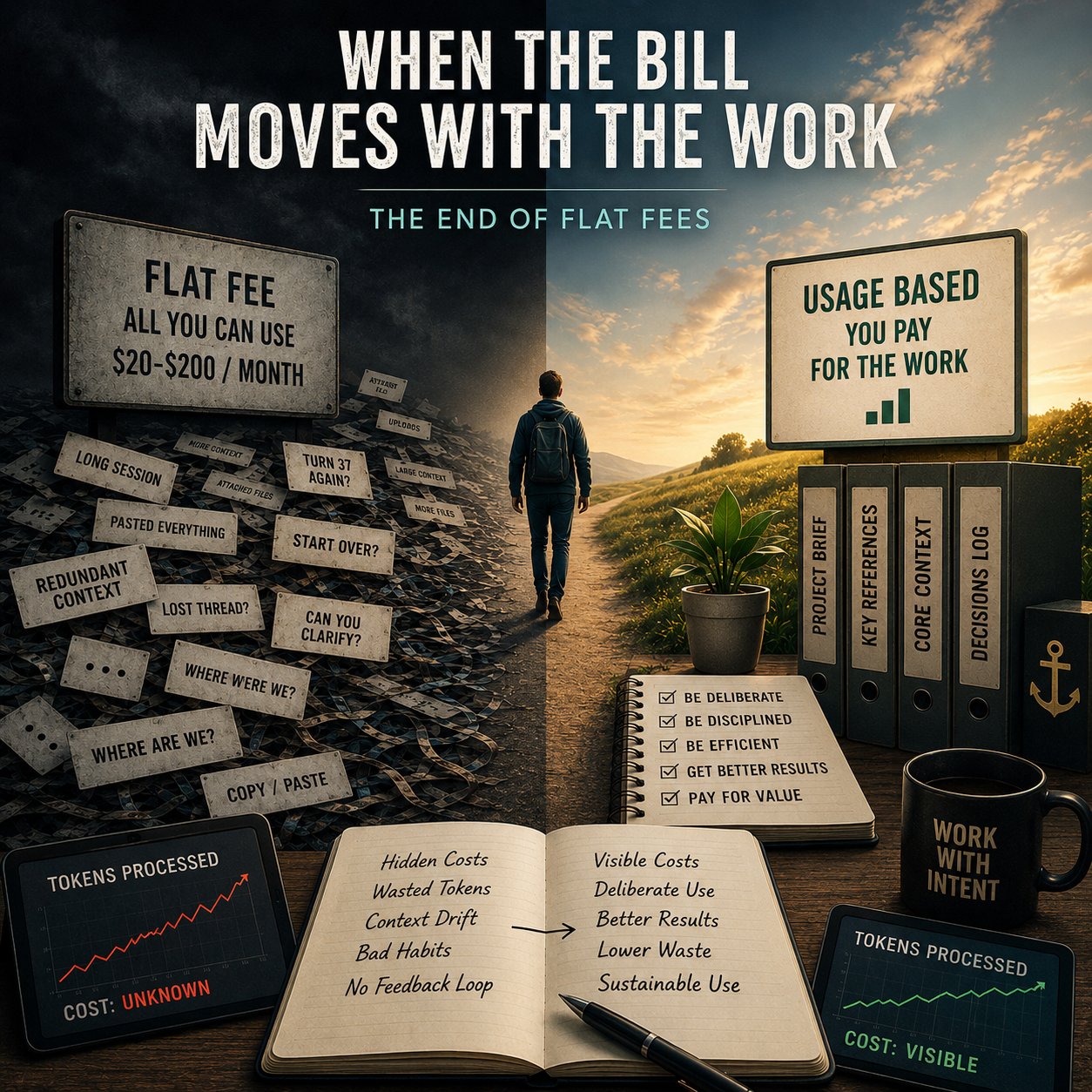
The Claude usage limit discourse has been getting louder for about a month. Pro tier throttling, sessions getting cut off mid-thought, “I’m a paying customer and I can’t use the product” posts circulating every few days. Most of the explanations focus on infrastructure: Anthropic can’t keep up with demand, the model is too expensive to serve at the current price point, the limits are a temporary measure while capacity catches up.
That’s part of the picture. The other part is that subscription pricing has been carrying a lot of weight it wasn’t designed to carry, and the weight is starting to crack the floor.
Here’s what I mean. For most of the last two years, AI has felt free at the margin. You pay your $20 or $200 a month and then you use the thing. The bill doesn’t move when you use it badly. It doesn’t move when you reload the same 60,000 tokens of context across forty turns to ask one question. It doesn’t move when you let a session run for six hours and watch the model’s outputs slowly lose their grip on what you actually asked for. The cost is hidden behind a flat rate, which means the cost feels like zero.
That arrangement is ending. Usage caps, throttles, tier boundaries, and credit meters are becoming more visible across the major platforms. The visible price isn’t changing yet, but the visible product is shrinking, which is the same thing wearing a different hat. And underneath the consumer tier, the actual economic model is already per-token for anyone using the API. Per-token is what the infrastructure has always cost. The subscription was a bet that average usage would stay low enough to absorb the heavy users, and heavy users keep getting heavier.
So here is the thing worth noticing. The transition from hidden cost to visible cost is going to be unkind to people who built their AI practice during the subsidy. The practical question, then, is not whether people are sending too many messages. It is where the hidden repetition lives.
Where the tokens actually go
The leak most people picture, “I’m sending too many messages,” is almost never the real problem. The real problem is context that compounds.
A long session accumulates. Every turn replays everything that came before it. By turn thirty, the model is re-processing your entire conversation history every time you say anything, plus whatever system prompt or project knowledge is loaded, plus any files you’ve attached. The “small” follow-up question isn’t small. It’s the original prompt plus the next twenty-nine turns plus the new question, every single time. A forty-turn session can easily process the same opening context forty times.
The second leak is undisciplined ingestion. People paste in the entire document, the entire codebase, the entire chat log, when what they need is a targeted reference. The model doesn’t care. It will dutifully process all of it. You just paid to load 40,000 tokens to ask a question that needed 2,000.
The third leak is the most subtle and the most expensive: long sessions that drift. The Synthience Institute has a published protocol called CRD, Context Representation Drift, that names what happens when an AI system’s effective working representation of earlier material degrades over the course of a long session. Drift isn’t only a quality problem. It is a cost problem too, because the session that is losing fidelity is also the session burning the most tokens per turn. You pay more and get less. The bill rises and the work degrades in the same motion.
These three leaks compound. A session with heavy ingestion accumulates faster. An accumulated session drifts sooner. A drifting session produces work the user has to redo. The redo happens in the same session because the user doesn’t want to “start over,” which means the leaking session now has to carry the cost of its own degradation. This is the shape of token waste at scale, and it has very little to do with how many messages you send.
What deliberate use actually looks like
Naming the leaks is the easy part. The harder part is changing the habit. A few specific shifts that have made the biggest difference in my own work:
End sessions when they’re done. When a session has done what you needed, close it. Don’t drag context around for sentimental reasons. The fourth hour of a session is almost never as sharp as the first hour of a new one, and it costs more per turn. The instinct to “keep going so I don’t lose context” is the instinct that produces the most expensive sessions.
Externalize the stable material. If you’re going to work with a body of material across many sessions, don’t rebuild it conversationally every time. Put the stable parts into maintained project files, reference documents, or briefs, and load only what the current task actually needs. This is the operational shift behind what the Institute calls Continuity Anchoring: coherence across sessions comes from stable external structure, not from dragging the chat history forward.
Ingest like it costs money, because it does. Before you paste in 30,000 tokens of something, ask whether the model needs all of it for this specific task. Often, the answer is no. A clear pointer (“here’s the relevant section, the rest is for context if asked”) beats a wall of text every time.
Notice drift and act on it. If the model is starting to lose track of what you established three turns ago, the session is not getting worse for free. You are paying premium prices for degraded output. Cut the session. Brief a new one with the relevant artifacts. The reluctance to restart is often the most expensive habit in the whole stack.
The shift that’s coming
When pricing becomes visible, these stop being abstract good practices and start being the difference between a forty dollar month and a four hundred dollar month for the same actual work output. The people who already work this way will barely notice the transition. The people who learned AI inside the subsidy era are about to find out what the work costs.
Subscription pricing was always a temporary arrangement, an industry-wide subsidy that let people learn the tools without learning the economics. The subsidy is ending. The work did not suddenly become expensive. The bill is catching up to costs that were already being incurred.
If you want to be ready, the move isn’t to use AI less. It’s to use it more deliberately. Same outputs, smaller bill. That gap, between deliberate and undeliberate use, is about to become legible in a way it never has been before.
New articles in full, plus a short note on each new paper, by email: Subscribe on Substack →
Further reading
The protocols referenced in this note are published Institute frameworks, both archived with permanent DOIs on Zenodo:
- SF0039: Context Representation Drift (CRD) — the named protocol for what happens when an AI system’s working representation of earlier material degrades over the course of a long session, and why drift is a cost surface as well as a quality surface.
- SF0005: Continuity Anchoring Mechanism (CAM) — the operational basis for the “externalize the stable material” move: coherence across sessions comes from stable external structure, not from dragging the chat history forward.
Published Institute documents are archived with permanent DOIs at the Synthience Institute community on Zenodo.