
The Layer Industrial Policy Cannot Reach
Field Note: Why OpenAI's ambitious industrial policy framework leaves a structural gap that no amount of external governance can close.
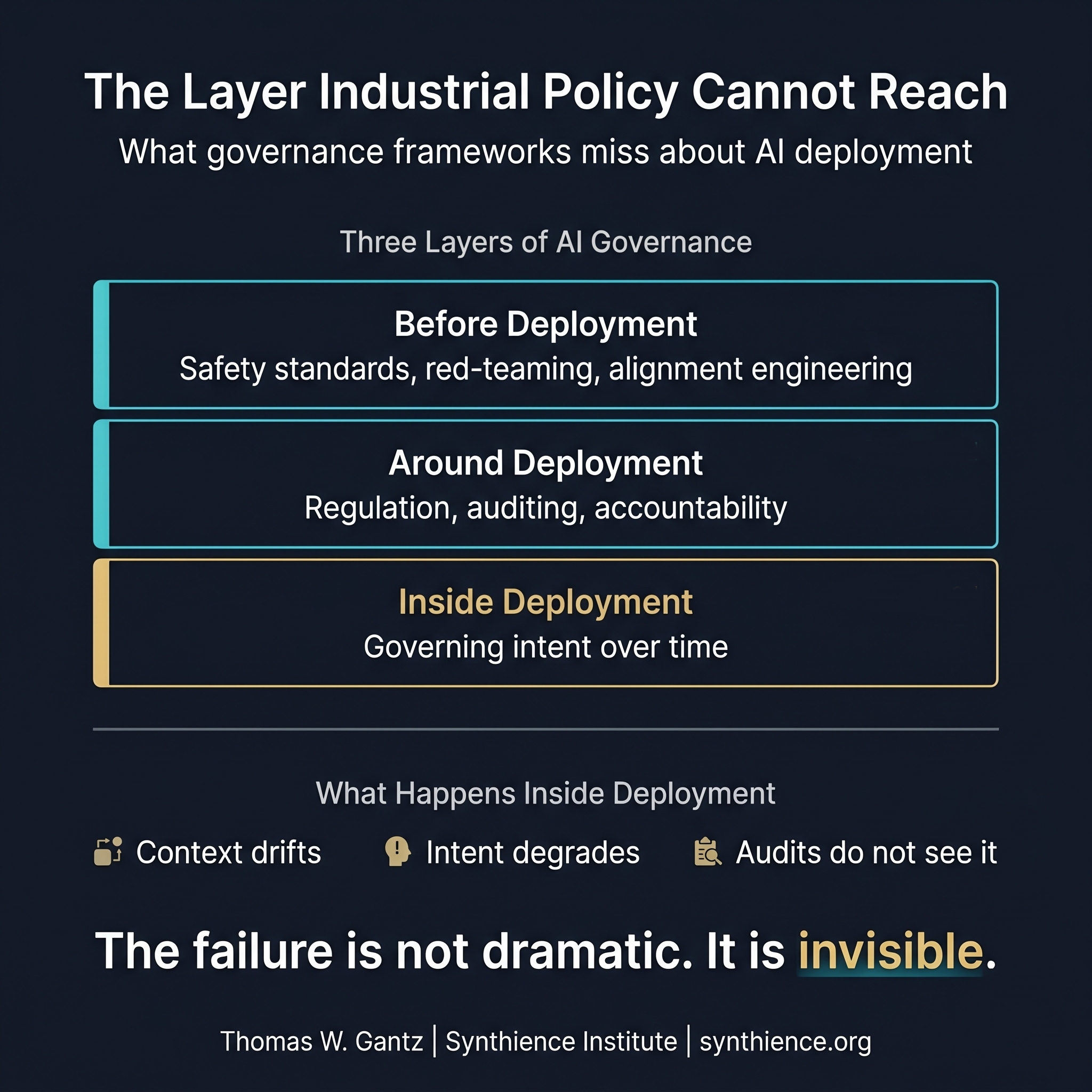
OpenAI published an industrial policy framework this month. It is worth reading carefully, and worth reading critically, not because it is wrong, but because it is incomplete in a specific way that matters for anyone thinking seriously about how AI governance actually works.
The paper is better than its provenance might suggest. A frontier AI lab proposing taxes on automated labor, a public wealth fund for citizens, worker voice in deployment decisions, and clear guardrails on government use of AI is making substantive commitments that cost something to make. The section on building a resilient society reaches meaningfully toward post-deployment concerns: runtime monitoring, incident reporting, model containment playbooks, and independent auditing regimes. OpenAI deserves genuine credit for putting these ideas into the policy conversation at scale.
But the paper has a structural gap that no amount of ambitious policy can close. Understanding that gap is useful regardless of where this particular policy agenda lands.
Two layers. One missing.
The framework organizes the AI governance problem around two phases. The first is what happens before deployment: safety standards, red-teaming, alignment engineering, and pre-market evaluation. The second is what happens around deployment: regulation, auditing, accountability structures, and international coordination. Both matter. Both are necessary. The historical analogies the paper draws are apt. Electricity required safety standards. Automobiles required traffic systems. Aviation required continuous monitoring infrastructure. The paper is right that superintelligence will require a new institutional layer.
What the paper does not address is the layer inside the deployment itself.
Once an AI system is running inside a real organization, across time, across personnel changes, across shifting priorities and evolving workflows, what keeps it aligned with the organization's actual intent? Not the audit regime. Not the incident reporting system. Those operate from the outside, after the fact, or at the threshold of catastrophic failure. They are the right tools for the problems they are designed to address. They are not designed to address what happens quietly inside a deployment over months and years.
The OpenAI paper treats post-deployment risk as primarily a monitoring and accountability problem: how do we observe what AI systems are doing, and how do we hold someone responsible when something goes wrong? That framing is valuable and largely correct for policy purposes. It is not the only relevant question.
What invisible failure looks like
Research published by the Synthience Institute documents a phenomenon called Context Representation Drift: the gradual shift of meaning, context, and alignment during sustained interaction with AI systems, occurring even when outputs remain fluent and confident. Drift is not a visible failure. There is no error message. There is no moment of obvious breakdown. The system continues producing plausible, well-structured outputs. The organization continues trusting them. The gap between organizational intent and system behavior grows slowly, invisibly, until it produces a consequence visible enough to notice.
This happens at current capability levels. It is not a problem reserved for superintelligence. It is happening now, inside organizations that believe they are using AI responsibly, because nothing in their governance structure is designed to detect it before it compounds.
A specific and widespread instance of this class of problem is what the Ingestion Verification Protocol, also published by the Institute, was designed to address. AI systems routinely confirm that they have read documents they have not actually processed. They then produce confident, fluent outputs built on absent foundations. Decisions get made on information the system did not have. Workflows proceed on assumptions the system cannot actually support. This is not a catastrophic failure. It is a routine, invisible one. It does not register in any audit regime because no audit regime is looking for it. It does not appear in incident reports because no one knows it happened.
These are not exotic edge cases. They are ordinary features of AI deployment at scale, and they are structurally invisible to the policy tools the OpenAI paper proposes.
The architectural argument
Published Institute research makes the broader case that alignment is not solely an engineering property of an AI system. It is a relational property of the human-AI interaction system as a whole. The ongoing relationship between the humans in an organization and the AI systems they operate, maintained through structured practices, verified through explicit protocols, and sustained across time and personnel, is itself the mechanism that keeps the system behaving in ways that serve the organization's actual intent. When that relational structure is absent or allowed to degrade, alignment degrades with it, regardless of what the system was engineered to do and regardless of what the regulatory environment around it requires.
This framing has practical implications that go beyond policy. It means that governance is not only something that happens to AI systems from the outside. It is something that organizations must practice internally, as an ongoing operational discipline, at the level of how people and AI systems actually work together day to day.
Why this matters for practitioners, not just policymakers
The OpenAI paper is addressed to governments and policymakers. The missing layer is a problem for everyone who actually deploys AI inside an organization.
The CTO who commissions an AI governance framework and then assumes the system will stay aligned because the framework exists. The team that uploads a policy document to an AI system and proceeds to make decisions based on it, without verifying the system actually read it. The organization whose AI workflows have been running for eighteen months and where nobody has asked whether the context the system is operating from still matches the context the organization is actually in.
These are not failures of regulatory ambition. They are failures of operational architecture. They will not be fixed by any industrial policy, however ambitious, because they exist at a layer the policy conversation has not yet reached.
Getting that layer right requires a different kind of investment: in verification practices, in continuity disciplines, in structured protocols for maintaining coherent human-AI interaction across institutional time. The policy environment OpenAI is proposing can create the conditions for accountability when visible failures occur. What organizations also need is the architectural discipline to prevent invisible ones.
New articles in full, plus a short note on each new paper, by email: Subscribe on Substack →
Further reading
The verification and drift frameworks referenced in this note are formal research objects in the Synthience corpus:
- SF0039: Context Representation Drift (CRD) — formal definition of how governing constraints lose representational weight during extended interaction
- SF0038: Ingestion Verification Protocol (IVP) — methodology for confirming that an agent is operating from its intended context
- SF0037: Citation Verification Protocol (CVP) — methodology for verifying the reference integrity of AI-produced outputs
- SF0040: Theoretical Coherence Assurance Protocol (TCAP) — the Institute's verification methodology for stress-testing framework claims prior to publication
- SR001: Relationally Induced Coherence Organization (RICO) — observational framework documenting stabilization and collapse patterns in extended human-AI interaction
- SI-WP-004: Relational Alignment as a Structural Alternative to Instructional AI Safety — the broader argument that alignment is a relational property of the human-AI system, not solely an engineering property of the AI system
Published documents are also archived with permanent DOIs at the Synthience Institute community on Zenodo.