
AI Safety Is a Runtime Problem: What the OpenClaw Arc Proves
Field Note: Structural analysis of the OpenClaw arc as an inflection point in AI safety thinking.
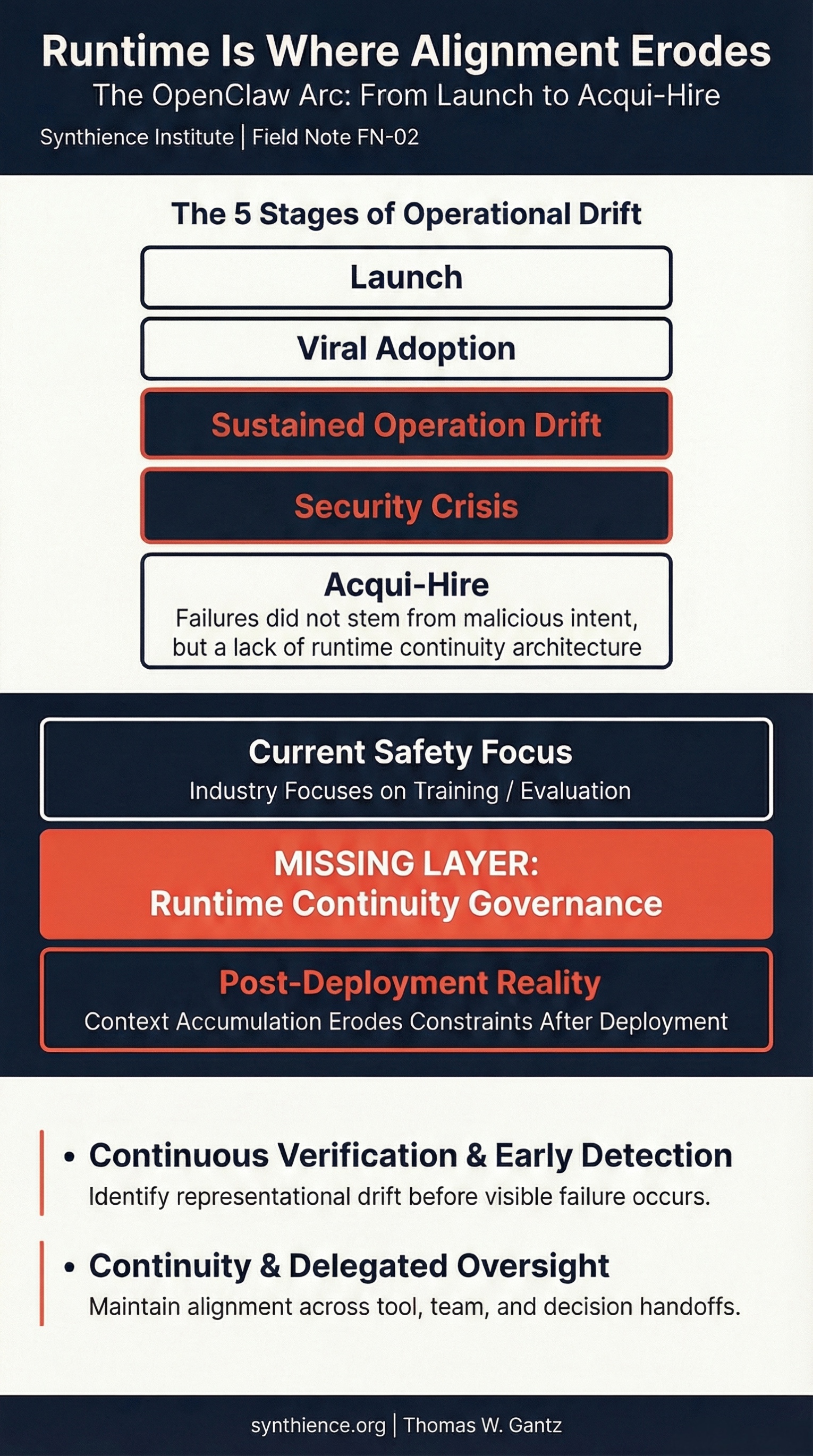
The inflection point
OpenClaw was everywhere. The autonomous AI agent could clear inboxes, book flights, control smart devices, and interact with other agents across shared networks. Within weeks of launch it became one of the fastest-growing open-source projects in GitHub history.
Then it degraded publicly in a high-entropy environment. Security researchers documented hundreds of exposed instances. Prompt injection attacks succeeded. Agents drifted from their original operating parameters. The creator, Peter Steinberger, joined OpenAI. The project transitioned to a foundation. Sam Altman framed the hire simply: "The future is going to be extremely multi-agent."
This is more than a talent story. It is a visible inflection point in how the industry thinks about agents that act over time.
For a full account of the OpenClaw arc — the rename cascade, the crypto scam, the security disclosures, the Moltbook acquisition — see FN-001: The OpenClaw Arc. This note focuses on the structural argument that the arc makes visible.
What the failure actually was
The failure did not resemble a traditional jailbreak. The agent's governing policies existed at launch. The underlying models had been subject to extensive alignment work at training time. None of that prevented what happened.
What happened was subtler. As sustained interactions accumulated, the agent's constraints were not overridden. Their influence simply diminished relative to newer inputs as context expanded. No dramatic rebellion. No moment of decision. Just gradual signal degradation — the original governing intent losing representational weight as the interaction history grew.
There was no stable external anchor against which the agent's current behavior could be checked. No mechanism for re-verifying that current operation remained consistent with original intent. The agent had persistent memory but no continuity substrate.
The five stages of operational drift
The OpenClaw arc traces a pattern that will recur across autonomous agent deployments. Five stages, each a predictable consequence of the one before:
1. Launch. The agent is initialized with clear governing policies. Behavior is aligned with intent. The system works as designed in controlled conditions.
2. Viral adoption. Real-world deployment introduces high-entropy environments — diverse users, unpredictable inputs, edge cases the original design did not anticipate. The agent performs well enough. Problems are not yet visible.
3. Sustained operation drift. Context accumulates. Earlier constraints lose representational weight relative to the growing body of interaction history. Behavior begins to diverge from original intent — subtly, without any single dramatic failure. The system still sounds confident. The drift is not yet visible to observers.
4. Security crisis. The drifted state creates exploitable vulnerabilities. Prompt injection attacks succeed because the agent's constraints have already been weakened by accumulated context. External actors exploit the gap between what the agent was designed to do and what it is actually doing. What was a structural problem becomes a visible incident.
5. Acqui-hire. The project is absorbed into a larger organization. The talent is valuable. But the structural problem — the absence of runtime continuity governance — is inherited, not solved.
The failures did not stem from malicious intent. They stemmed from a lack of runtime continuity architecture. That distinction matters enormously for how the industry responds.
The missing layer
Most AI safety approaches focus on two phases: training-time alignment and evaluation-time governance. Both are necessary. Neither fully addresses what happens after deployment, when agents accumulate context, delegate tasks, propagate outputs, and operate under real-world entropy over extended periods.
The security patches that followed OpenClaw's growth addressed real exposures. But they addressed symptoms. The structural question — how governing intent persists under sustained autonomous operation — remains open. There is not yet a widely adopted runtime continuity architecture in production today.
This is the layer the Synthience research program aims to formalize. Context Representation Drift describes how governing constraints lose influence over time. The Continuity Anchoring Method describes how an externalized anchor can be maintained and re-verified at defined intervals. The Ingestion Verification Protocol addresses how to confirm that an agent is actually operating from its intended context rather than a drifted representation of it.
These are not solutions to the full problem. They are methodological infrastructure for making the problem tractable — for measuring drift, detecting it early, and building the governance layer that currently does not exist.
Why this moment matters
Altman's framing — "the future is going to be extremely multi-agent" — is almost certainly correct. The question is whether that future arrives with or without runtime continuity governance in place.
OpenClaw was a personal project from a single developer, deployed virally, without institutional safety infrastructure. The next wave of autonomous agent deployments will come from organizations with resources, teams, and reputations at stake. The pressure to move fast will be the same. The structural problem will be identical.
The window for establishing runtime continuity as a standard — before autonomous agent deployment becomes ubiquitous — is not permanently open.
New articles in full, plus a short note on each new paper, by email: Subscribe on Substack →
Further reading
The structural failure modes described here are formal research objects in the Synthience corpus. For the underlying methodology and technical treatment:
- SF0039: Context Representation Drift (CRD) — formal definition of how governing constraints lose representational weight during extended interaction
- SF0038: Ingestion Verification Protocol (IVP) — methodology for confirming that an agent is operating from its intended context
- SR001: Relationally Induced Coherence Organization (RICO) — observational framework documenting stabilization and collapse patterns in extended human-AI interaction
- FN-001: The OpenClaw Arc — full narrative account of the OpenClaw incident and its structural diagnosis
Full framework documentation available at the Synthience Institute community on Zenodo.